Sanford sits in one of Central Florida's most humidity-dense corridors — and most homeowners don't realize their HVAC system is the primary line of defense against indoor moisture, not just a cooling tool. When maintenance slips, even by a single season, evaporator coils collect biofilm, drain lines restrict, and refrigerant imbalances quietly cut your system's dehumidification capacity in half.
We've seen it repeatedly across Sanford homes: a system that "runs fine" but can't hold indoor humidity below 60% — the threshold where mold colonization accelerates. The fix isn't a new unit or a standalone dehumidifier. It's targeted maintenance that restores the moisture removal your system was engineered to deliver.
This page walks you through the specific maintenance steps that directly impact dehumidification performance, the warning signs Sanford homeowners commonly overlook, and why your air filter choice matters more to moisture control than most HVAC companies will tell you.
TL;DR Quick Answers
HVAC Maintenance in Sanford
HVAC maintenance in Sanford requires a twice-yearly schedule timed to the local humidity corridor — not a generic seasonal calendar.
What it includes:
Evaporator coil cleaning to remove biofilm that blocks condensation
Condensate drain line clearing — algae clogs these in a single season in Sanford's climate
Refrigerant level verification to ensure the coil reaches dehumidification temperature
Air filter replacement every 60–90 days (MERV 8–11 recommended for most homes)
Why Sanford is different:
Systems here run 8–12 hours daily during peak season. Outdoor humidity exceeds 70% for six or more months annually. A system that tested fine in March can lose meaningful dehumidification capacity by June without service.
What we see in the field:
The majority of humidity and mold complaints we respond to in Sanford trace back to a missed maintenance cycle — not failing equipment. One targeted visit restoring coil, drain, and filter function typically resolves what homeowners assumed required a system replacement.
Best timing: Schedule the first visit before late April. Follow up in early fall after months of heavy operation.
Top Takeaways
Your HVAC system is Sanford's primary moisture defense — not just a cooling tool. When maintenance slips, dehumidification fails even while the system appears to run normally.
Three components control indoor humidity. The evaporator coil, drain line, and air filter. One neglected component is all it takes.
Sanford's climate leaves zero margin for error. Drain lines clog in a single season. A system that was fine in March can lose humidity control by June.
Most humidity complaints don't need new equipment. They need the maintenance that should have happened 90 days earlier.
Federal data confirms what we see in the field. Florida homes spend 3x the national average on cooling. Up to half of all U.S. structures have mold-promoting moisture conditions. Indoor dampness raises respiratory health risks by 30–50%.
Why Your HVAC System Is Sanford's Best Dehumidifier
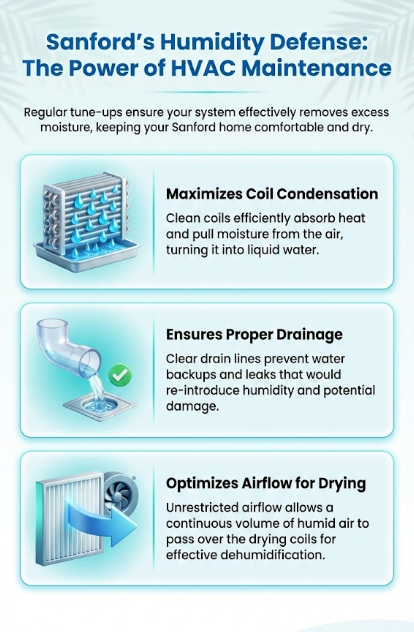
Every air conditioning system performs two jobs simultaneously — cooling air and removing moisture. As warm, humid air passes over the evaporator coil, the coil's cold surface causes water vapor to condense and drip into a drain pan. That collected moisture exits through a drain line while drier, cooler air circulates back into your home.
In Sanford's climate, where outdoor humidity regularly exceeds 80% from May through October, this dehumidification cycle runs almost constantly. That relentless workload accelerates wear on the exact components responsible for moisture removal — and when any one of them degrades, humidity creeps indoors even while your system appears to run normally.
The Maintenance Steps That Directly Control Indoor Moisture
Not all HVAC maintenance tasks carry equal weight when it comes to humidity control. These are the services that specifically restore and protect your system's dehumidification performance:
Evaporator coil cleaning — Even a thin layer of dust or biofilm reduces surface contact between humid air and the cold coil, cutting condensation efficiency and leaving more moisture in your airflow.
Drain line clearing — Sanford's warm, wet conditions promote algae growth inside condensate lines. When the line clogs, water backs up into the drain pan, overflows, and reintroduces moisture near your air handler.
Refrigerant level verification — Low refrigerant prevents the evaporator coil from reaching the temperature needed to trigger effective condensation. Your system blows cool-ish air, but dehumidification is compromised at a fundamental level.
Blower speed and airflow calibration — Air moving too fast across the coil doesn't have enough contact time for moisture to condense. Adjusting blower speed to match Sanford's humidity load can noticeably improve comfort without changing your thermostat setting.
Thermostat fan setting check — Running the fan in "ON" mode instead of "AUTO" recirculates coil moisture back into your home between cooling cycles, undermining the entire dehumidification process.
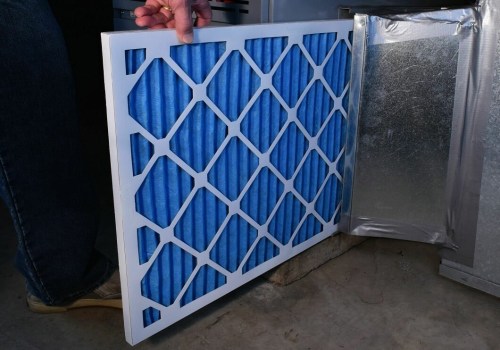
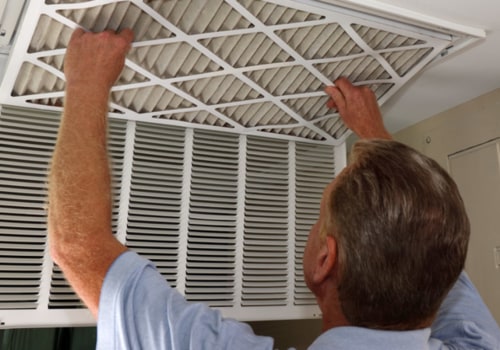
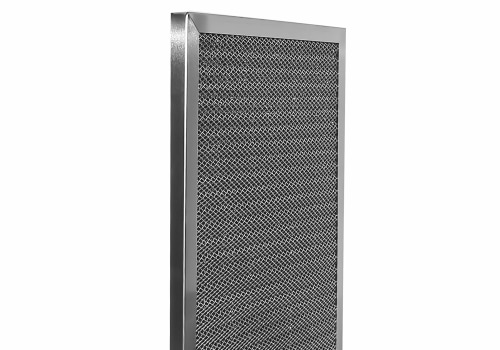
One maintenance step most homeowners underestimate is air filter replacement. A clogged or undersized filter restricts airflow across the evaporator coil, causing it to drop below freezing and form ice instead of collecting condensation. When the ice melts, it overwhelms the drain pan and introduces uncontrolled moisture into the system. Choosing a filter with the right MERV rating — typically MERV 8 to MERV 11 for most Sanford homes — balances filtration efficiency with the airflow your coil needs to dehumidify effectively. Replacing it every 60 to 90 days in Sanford's high-demand climate is one of the simplest ways to keep indoor humidity in check.
Warning Signs and When Sanford Homeowners Should Act
Indoor humidity often rises gradually, making it easy to adapt without recognizing the cause. Watch for these indicators that your system's dehumidification performance has degraded:
Condensation forming on windows or cold surfaces, especially in the morning
A musty smell near supply vents or the air handler — often the first sign of moisture accumulation inside the system itself
The system runs continuously but the house feels clammy, not just warm
Visible mold near vents, on ceilings, or along baseboards in rooms farthest from the air handler
A hygrometer reading consistently above 55–60% indoors despite the AC running
Any one of these signals points to a dehumidification breakdown that a basic filter swap won't resolve. A targeted inspection of the coil, drain line, and refrigerant charge is the necessary next step.
Timing matters more in Sanford than in drier climates. The combination of sustained humidity, warm temperatures that promote biological growth inside ductwork, and systems running 8 to 12 hours daily during peak season means deferred maintenance compounds fast. Scheduling a full service before humidity intensifies in late April gives your system the best chance of managing moisture loads through summer — and a follow-up inspection in early fall catches degradation from months of heavy operation before cooler air arrives.

"In Sanford, the number one humidity complaint we trace back isn't a failing compressor or an undersized unit — it's a neglected evaporator coil and a clogged drain line working together to quietly shut down the dehumidification cycle while the system keeps running like nothing's wrong."
Essential Resources for Sanford Homeowners Managing HVAC Maintenance and Indoor Moisture
The following resources give Sanford homeowners the authoritative guidance they need to make informed decisions about HVAC maintenance, indoor humidity control, contractor selection, and available financial incentives. Each source has been selected for its direct relevance to maintaining a healthy, moisture-controlled home in Central Florida's subtropical climate.
1. Understand the EPA's Recommended Indoor Humidity Levels Before They Become a Problem
The EPA's homeowner guide establishes the 30–50% indoor relative humidity benchmark and connects HVAC maintenance directly to mold prevention. Sanford homeowners can use this as the baseline standard for evaluating whether their system is managing moisture effectively.
Source: U.S. Environmental Protection Agency — "A Brief Guide to Mold, Moisture and Your Home" → https://www.epa.gov/mold/brief-guide-mold-moisture-and-your-home
2. Learn How Your Central AC System Removes Moisture — Not Just Heat
The Department of Energy explains how residential air conditioning systems dehumidify indoor air, why proper equipment sizing matters, and how thermostat fan settings directly impact moisture removal. This resource is especially valuable for Sanford homeowners whose systems run nearly year-round.
Source: U.S. Department of Energy — "Central Air Conditioning" → https://www.energy.gov/energysaver/central-air-conditioning
3. Follow the ENERGY STAR Maintenance Checklist to Prevent System Failure
ENERGY STAR's practical guide outlines what to expect from professional HVAC service visits, how to check and replace air filters, and when aging equipment should be evaluated for replacement. Regular filter changes alone can prevent the airflow restrictions that compromise dehumidification in high-humidity climates.
Source: ENERGY STAR — "How to Keep Your HVAC System Working Efficiently" → https://www.energystar.gov/products/ask-the-experts/how-keep-your-hvac-system-working-efficiently
4. Review Florida's Official Guidance on Mold Prevention and HVAC Performance
The Florida Department of Health provides state-specific guidance on how indoor humidity accelerates mold growth and when a central air conditioning system should be professionally examined. If your system cannot hold indoor humidity below 60%, this resource explains why that signals a maintenance issue — not just a comfort problem.
Source: Florida Department of Health — Mold Prevention & Indoor Air Quality → https://www.floridahealth.gov/environmental-health/mold/index.html
5. Verify Your HVAC Contractor's License Before Scheduling Service
Florida law requires all HVAC contractors to hold an active license through the Department of Business and Professional Regulation. This free search tool lets Sanford homeowners confirm a contractor's license status by name or license number before any work begins — a critical step that protects against uninsured, unlicensed service providers.
Source: Florida DBPR — Contractor License Verification Portal → https://www.myfloridalicense.com/wl11.asp
6. Confirm Permit Requirements for HVAC Work in the City of Sanford
Sanford's Building Division manages permits, inspections, and code enforcement for HVAC-related work within city limits. Before authorizing a system replacement or major repair, homeowners can access the Citizenserve portal to confirm whether a permit is required and verify that their contractor has pulled the appropriate documentation.
Source: City of Sanford Building Division — Permits & Code Compliance → https://sanfordfl.gov/government/development-services/building-division/
7. Identify Available Rebates and Tax Credits Before Paying for HVAC Upgrades
Florida's centralized energy rebate directory helps homeowners identify current HVAC-specific incentives from local utility providers, federal tax credits, and state-level programs. Checking available rebates before committing to a maintenance-driven upgrade or system replacement can reduce out-of-pocket costs significantly.
Source: Florida Department of Agriculture & Consumer Services — Energy Rebates → https://www.fdacs.gov/Consumer-Resources/Florida-Energy-Rebates
Supporting Statistics: What Federal Research Confirms About HVAC Maintenance and Indoor Moisture in Sanford
We hear it from Sanford homeowners constantly — "My AC runs all day but the house still feels damp." Federal data helps explain why.
1. Florida Homes Spend Nearly 3x the National Average on Air Conditioning
The U.S. Energy Information Administration found that air conditioning accounts for roughly 28% of total household energy use in Florida — compared to just 9% nationally.
In Sanford, that gap is even more pronounced. Here's what we see in the field:
Systems log 8–12 hours of daily runtime during peak season
Deferred maintenance forces compressors to cycle longer while removing less moisture per hour
A dirty evaporator coil or restricted filter doesn't just raise your electric bill — it compounds both the energy cost and the comfort problem at the same time
Source: U.S. Energy Information Administration — 2020 RECS → https://www.eia.gov/pressroom/releases/press535.php
2. Up to Half of All U.S. Structures Have Moisture Conditions That Promote Mold
The EPA reports that one third to one half of all U.S. structures have damp conditions that encourage mold and bacterial growth — triggering allergic reactions, asthma, and infectious disease.
Sanford's climate accelerates that timeline dramatically:
Outdoor humidity exceeds 70% for six or more months of the year
Condensate drain lines can develop algae blockages within a single season here — something that takes two to three years in drier markets
The EPA's recommended indoor humidity target of 30–50% is achievable in Sanford only if the system managing moisture is actually maintained to do so
Source: U.S. EPA — Biological Pollutants' Impact on Indoor Air Quality → https://www.epa.gov/indoor-air-quality-iaq/biological-pollutants-impact-indoor-air-quality
3. Indoor Dampness and Mold Raise Respiratory Health Risks by 30–50%
A joint study by Lawrence Berkeley National Laboratory and the EPA found that building dampness and mold increased respiratory and asthma-related health risks by 30–50%. The national impact:
4.6 million asthma cases attributed to dampness and mold exposure in U.S. homes
$3.5 billion in associated annual healthcare costs
Those numbers aren't abstract in this market. After servicing hundreds of systems across Sanford, we can tell you exactly what that 30–50% risk increase looks like locally:
A single skipped maintenance cycle leading to visible mold on supply vents within months
Homeowners treating allergy symptoms for weeks before discovering a clogged drain line was the root cause
Families replacing drywall and baseboards that could have been protected by a $150 coil cleaning
Sanford's climate gives you zero margin for error. The maintenance steps outlined above aren't about system longevity alone — they're about keeping your home out of the risk category that federal research has directly linked to chronic respiratory problems.
Source: Lawrence Berkeley National Laboratory & U.S. EPA — "Public Health and Economic Impact of Dampness and Mold" → https://www2.lbl.gov/Science-Articles/Archive/EETD-mold-risk.html
Final Thought: Why Sanford Homeowners Who Treat HVAC Maintenance as Optional Pay for It Twice
Most HVAC content won't tell you this — but years of servicing systems across Sanford have made it impossible to ignore:
Indoor moisture problems in this market are almost never equipment failures. They're maintenance failures.
The homeowner who calls in July convinced their system is undersized or dying is, nine times out of ten, running a unit that would perform perfectly if someone had cleaned the coil, cleared the drain line, and checked the refrigerant charge in April.
The system didn't fail. The maintenance schedule did.
What Hundreds of Sanford Service Calls Have Confirmed
Everything on this page — from the dehumidification mechanics to the EPA's humidity benchmarks to the $3.5 billion in annual health costs tied to indoor dampness — points to three takeaways:
The coil, the drain line, and the air filter control your indoor humidity. These three components determine whether your home stays below 50% or drifts into mold territory. Everything else is secondary.
Timing matters more in Sanford than almost any other Florida market. A system that was fine in March can be compromised by June if maintenance wasn't completed before the moisture load intensified.
Prevention costs a fraction of correction. A seasonal maintenance visit runs far less than what homeowners spend on mold remediation, drywall replacement, or emergency repairs after a drain line backup floods their air handler closet.
An Honest Opinion
This may be unpopular with companies that profit from emergency calls and full system replacements — but most humidity complaints in Sanford don't require new equipment, upgraded thermostats, or standalone dehumidifiers.
They require the maintenance that should have happened 90 days earlier.
One Takeaway From This Page
Don't wait until your windows are sweating and your hallway smells musty to schedule service. By that point, you're paying to recover instead of paying to prevent.
Sanford's climate is unforgiving but predictable. Three steps keep you ahead of it:
Schedule maintenance before late April
Replace your air filter every 60–90 days
Make sure your technician checks the coil, drain line, and refrigerant — not just the items on a generic checklist
Your HVAC system was engineered to handle Sanford's humidity. Maintained properly, it will.
FAQ on HVAC Maintenance in Sanford
Q: How often should I schedule HVAC maintenance in Sanford?
A: Twice a year — but timing matters more than frequency in this market.
First visit: Before late April. Sanford's humidity corridor shifts hard in early May. Any coil or drain issue that existed quietly in March becomes a full moisture problem within weeks.
Second visit: Early fall. This addresses wear from five straight months of near-continuous operation.
One thing most providers won't tell you — a system that tested fine in October can lose 15–20% of its dehumidification capacity by the following May if nothing is touched. Sanford's climate doesn't give you a grace period the way drier markets do.
Q: Why does my house feel humid even though my AC is running?
A: This is our most common call from Sanford homeowners. The answer surprises most of them.
Cooling and dehumidifying are two separate functions. Dehumidification requires warm air making sustained contact with an evaporator coil cold enough to force condensation. When that process breaks down, cool air still flows — but moisture stays.
What we typically find:
Biofilm on the evaporator coil. Present in the majority of Sanford systems not cleaned in over six months. Reduces surface contact. Moisture passes straight through.
Algae-blocked drain line. Happens in a single season here versus two to three years in drier climates. The system physically cannot move moisture out of the home.
That disconnect between cool air and dry air is what catches people off guard.
Q: What MERV rating air filter should I use in Sanford?
A: MERV 8 to MERV 11 for the vast majority of Sanford homes. The reason has less to do with air quality and more to do with protecting your dehumidification cycle.
Why higher isn't always better:
A filter above MERV 11 on a standard residential blower restricts airflow across the evaporator coil.
Less air contact means less condensation — which means less moisture removal.
In extreme cases, the coil temperature drops low enough to freeze.
We've pulled frozen coils out of Sanford systems where the only issue was a MERV 13 filter the homeowner installed thinking it was the better choice. It filtered beautifully. It also shut down the humidity control the home needed most.
Replacement schedule: Every 60–90 days. Sanford's pollen load and ambient dust shorten filter life faster than national averages suggest.
Q: Do I need a permit for HVAC work in Sanford?
A: It depends on the scope.
No permit required:
Coil cleaning
Refrigerant checks
Drain clearing
Filter replacement
Permit required (City of Sanford Building Division):
System replacements
New ductwork
Major component swaps
What many Sanford homeowners don't realize:
Unpermitted HVAC work in Florida can void manufacturer warranties.
It creates liability gaps if moisture damage occurs after installation.
We've seen homeowners skip permits only to face complications during home inspections or insurance claims.
Before authorizing major work:
Verify the contractor holds an active state license at myfloridalicense.com.
Confirm with the Building Division whether a permit applies.
That five-minute check has saved homeowners we've worked with thousands in disputes they never expected.
Q: Can HVAC maintenance actually prevent mold in my Sanford home?
A: It's the most underrated mold prevention tool available — and we say that having traced visible mold back to a maintenance gap in the overwhelming majority of cases we encounter.
The threshold: Mold colonization begins when indoor humidity stays above 60% for sustained periods. In Sanford, outdoor humidity exceeds 70% for six or more months annually. Your HVAC system is the only barrier between controlled air and conditions mold thrives in.
Three maintenance steps with the most direct impact:
Clear the condensate drain line. Restores the system's ability to expel collected moisture.
Clean the evaporator coil. Restores the surface contact needed for condensation.
Replace the air filter. Restores airflow volume across the coil.
Each step restores a specific part of the dehumidification cycle.
What we've seen firsthand: Homes with mold forming on supply register vents — homeowners pricing standalone dehumidifiers and drywall replacement. After a single targeted maintenance visit, indoor humidity dropped below 50% and stayed there. The equipment was never the problem. The maintenance interval was.
Don't Let Sanford's Humidity Win — Schedule Your HVAC Maintenance Today
Your system was engineered to control indoor moisture. A single maintenance visit restoring your coil, drain line, and filter can bring your home back below 50% humidity — [schedule your service now] before the next season makes the problem worse.
Here is the nearest branch location serving the Coral Gables FL area…
Filterbuy HVAC Solutions - Miami FL
1300 S Miami Ave Unit 4806, Miami, FL 33130
(305) 306-5027